diemut
THE PRAYER
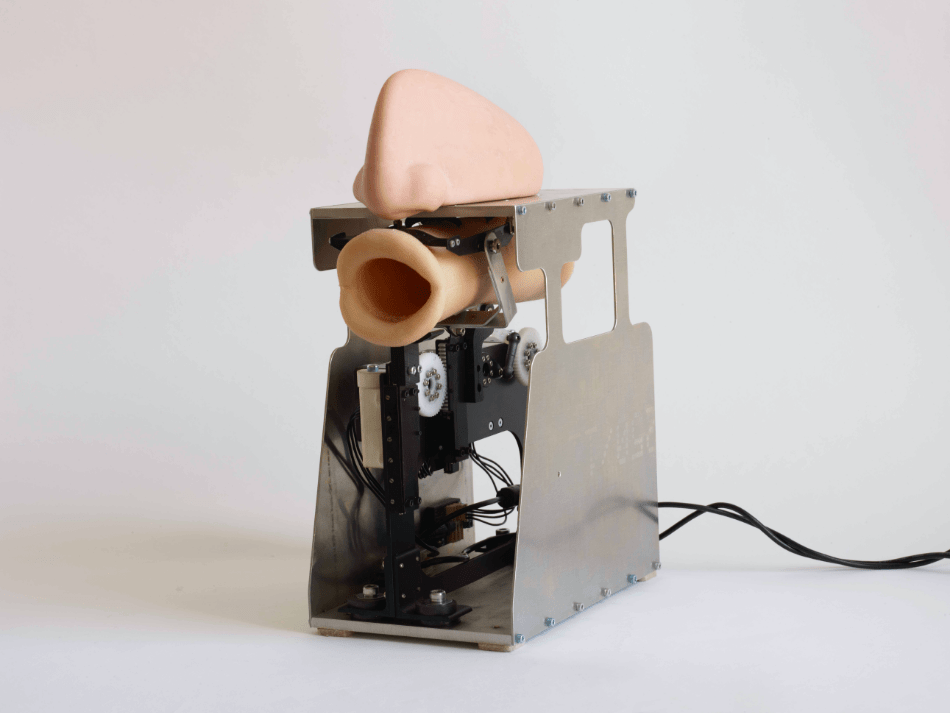
THE PRAYER
OR
An experimental set-up to explore the possibilities of an approximation to celestial and numinous entities by performing a potentially never-ending chain of religious routines and devotional attempts for communication through a self-learning software.
2020
AI machine / Multi media
Sizes machine w:14 cm x h: 35 x l: 24,5 cm
Aluminum frame, silicone, motors , plaster, monitor, printer; computerized system using neuronal machine learning software.
AI free text-generation for speech and singing, AI text to speech – generation in real time, audio / mouth movement synchronization
THE PRAYER
View #3
at Centre Pompidou, Paris
The presented spoken prayers in the video above are the original real-time new created contemplation of the AI machine The Prayer.
The Prayer is an art-installation that tries to explore the supernatural through artificial intelligence with a long term experimental set up. A robot – installation operates a talking mouth that is part of a computer system to try to connect to ‘the divine’ the supernatural or ‘the noumenal’ as the mystery of ‘the unknown’, using deep learning, a method of machine learning, that attempts to mimic human brain circuits with a self learning software.
According to the conviction of most scientists within the research about artificial intelligence, robots as self-learning software running on so called neuronal networks of deep learning should in principle be able to mimic or generate any form of human consciousness even in a superior way. We want to test and explore this ability on religious experiences, thoughts and behavior with a long term experimental set up.
How would a divine epiphany appear to an artificial intelligence? The question may sound absurd but the focus of the project could maybe shed light on the difference between human and AI machines in the debate about mind and matter and reflect on the potentials and implications of deep learning AI within both its narrow setting and general state.
THE PRAYER
View #3
At Centre Pompidou, Paris
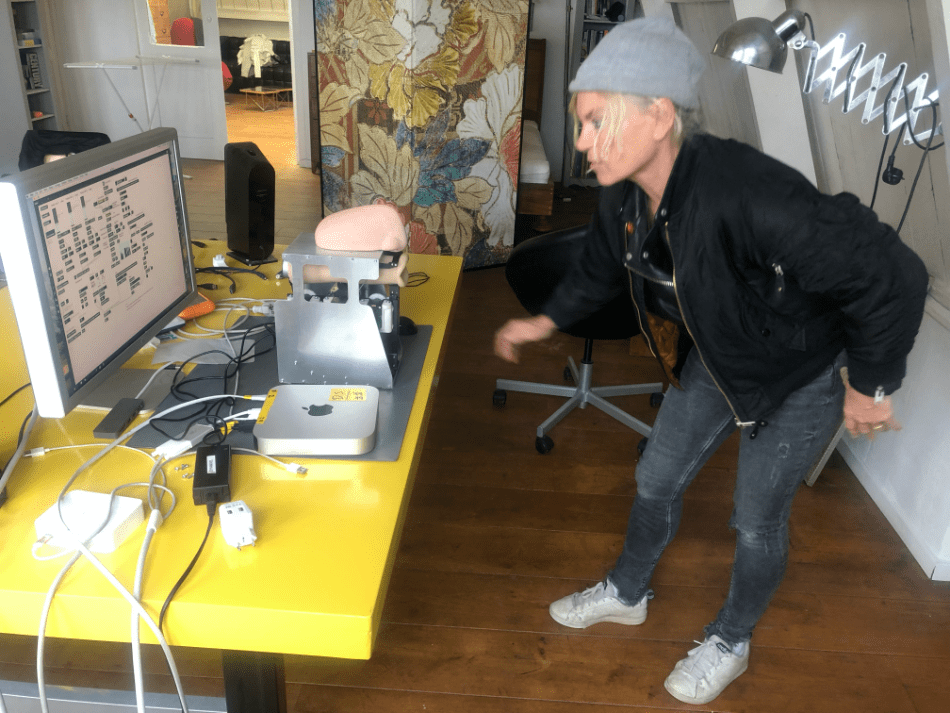
In The Prayer we see a small installation, an artificial mouth connected to a nose: two organic and partly flexible forms mounted in a technical construction attached to a computer with a self-learning software. The whole set-up mimics the human speech apparatus in a simplified way. It is constructed of motor-controlled rudiments of vocal organs such as a mouth and a vocal tract using an integrated speaker to produce sound. The machine voices canonized prayers from most known religions as well as personal contemplations, using deep learning techniques such as AI based free text generation as well as AI text to speech generation. The artwork challenges and explores the claim that in the future, machines and robots endowed with self-learning software running on so called neuronal networks of deep learning should in principle be able to generate or mimic any form of human intelligence and at some point exceed and outperform any such human capabilities.
The machines abilities are applied to religious experiences, thoughts and behavior with a long term experimental set up, embracing future potentials. Religion and faith as a practice about supernatural reasons to our existence are constitutional for cultures through all human history. In many cultures God has been seen as the point of the ultimate origin and cause as the unmoved mover, embracing all there is in infinity. The religious need obviously arises from the human urge to model the world, to cope with ‘the unknown’ and one’s own in part profound limitations. Since the age of enlightenment, science subverted most successfully quite some dogmas of religious convictions. While dogmas generally create claims or explanatory accounts for phenomena on a non-testable basis, science instead promotes fallible and testable knowledge based on reason, observation and calculation. Regardless of all success of reason, religious rituals and strategies, extending into their secular mutants still constitute an important and most powerful element within human behavior to shape and create identity and stability on both individual and social scale. In all forms of religious belief the connection and communication with the supernatural is attempted by diverse modes of meditation and praying. What happens with a self-learning software that executes almost all prayers, canonic or private, known to mankind? German theologian Rudolf Otto described this experience of the nouminous, what is essentially not nameable, as “mysterium tremendum”, a shuddering mystery. God reveals “itself” in a concurrence of experiences: awe, fright, uncanny, overwhelming. How would a divine epiphany appear to an artificial intelligence? This question may seem absurd, but it takes a stance on current states of deep learning and how shifts from reason to religious forms are taking shape. On the other hand it focuses on the experimental perspective of how future artificial intelligence could develop: Are all states of mind computable at some point along any future development including emotions, gut feelings etc.? Is quantification the means that underlies what we perceive as the diversity and qualitative variety of the existing universe? Will AI machines regardless of their different materialization in silicone turn over a certain period of time into any conscious state, generating meaningful understanding or at least develop as ‘an independent agent’ endowed with any form of self-interest? Or will AI be just an automata – a Vaucansan’s duck in essence, which can in its recent google version pass the Turing test by making a hairdresser appointment flawlessly. The 2000- year-old debate of mind and matter seems to be shaped in a much more concrete fashion through engineering: A self-driving car is an agent that makes (in ultimate consequence) ethical decisions. How could a more complex agent act? Which role will consciousness and emotion play and how would they be encoded? If such general artificial intelligence truly capable of generating or simulating human-like states that allow the machines to calculate or even comprehend their own limitations and potential threats? For example, could AI machines undergo perhaps similar developments that make human susceptible to religious connections or even superstition? Interestingly the current essentials of the most advanced processes of deep learning, in the so-called hidden layer structure, are not well understood. They turn out to be some kind of a black box. The programmer may tweak the matrix but he has not much of a clue how the machine exactly produces its results. The machine programs itself. These self learning programs create a point beyond which engaging with AI is in fact a leap of faith. Will we rely more and more on algorithms we do not even fully understand while giving them decisive powers instead of keeping the “dare to know” to ourselves? In addition AI can be fooled very easily. If one considers belief to not have to know everything at once, (a state which is claimed to be known in religion as epiphania), belief – as a degree of knowledge- seems very different from superstitious or religious belief, which is traditionally contrasted with (scientific) knowledge, but the neuronal structure embedded in the probabilistic mathematical matrix of deep learning processes seems to allow for both. One of the maybe most challenging questions of the experiment is whether the machine could and would connect through its own advanced technology to ‘the divine’, the noumenal as it appeared in various ways throughout the history of mankind in religious belief and philosophical speculation. Some of these philosophical questions that define our relationship towards the universe have shifted from the range of mere speculation to mathematical problems, physical concepts and experiments. Assuming there is a ‘God’, some kind of entity, maybe even of a numerical kind, who is merely and essentially described by its incomprehensibility: Will a machine be able to come in closer range and raise, for a bit, the veil? Might AI be able to tell us something relevant and new on ‘the incomprehensible’?

THE PRAYER
View #4
2020
at Centre Pompidou, Paris
AI machine / Multi media
Sizes machine w:14 cm x h: 35 x l: 24,5 cm
AI Modules / Technical Description
In The Prayer implemented a deep neural language model (based on a pre-trained GPT2 model) that learns the probability distribution of word sequences in text corpora. The system infers word meaning and grammar rules from word distribution, by encoding this information in tensors, which are then utilized to generate natural language, by predicting the next token. The deep network is fine-tuned on sacred texts, and as such it abstracts key features from this specific genre to generate original prayers, with their peculiar lexicon and syntax. The original prayers are generated as texts and are post-processed to clean structural errors (e.g. extreme punctuation) and introduce intonation indicators, such as speed or volume variations. The resulting post-processed text is then synthesized as voice by Amazon Polly, a neural text-to-speech AI module which reads the text aloud, taking into account the intonation tags. Finally, the voice is synchronized to the lip movements, to simulate the articulation of the prayers. The prayers are the original creations of the machine.
The established database to train the model consists of a collection of texts and prayers of all, obviously very diverse, world religions. To increase coverage and variability the database it is open to extension. The current list includes: Bible old and new Testament (Christian), Bhagavad Gita (Hinduism), Rig Veda of Hinduism, Koran (Islam), The Thirteen Classics of Confucianism, The Zhuang Zhou of Taoism, The Noble Eightfold Path of Buddhism The Talmud (Rabbinic Judaism), The Book of Mormon, (Mormons), Mayan Book of the Dead, The Popol Vuh and other prayer collections.
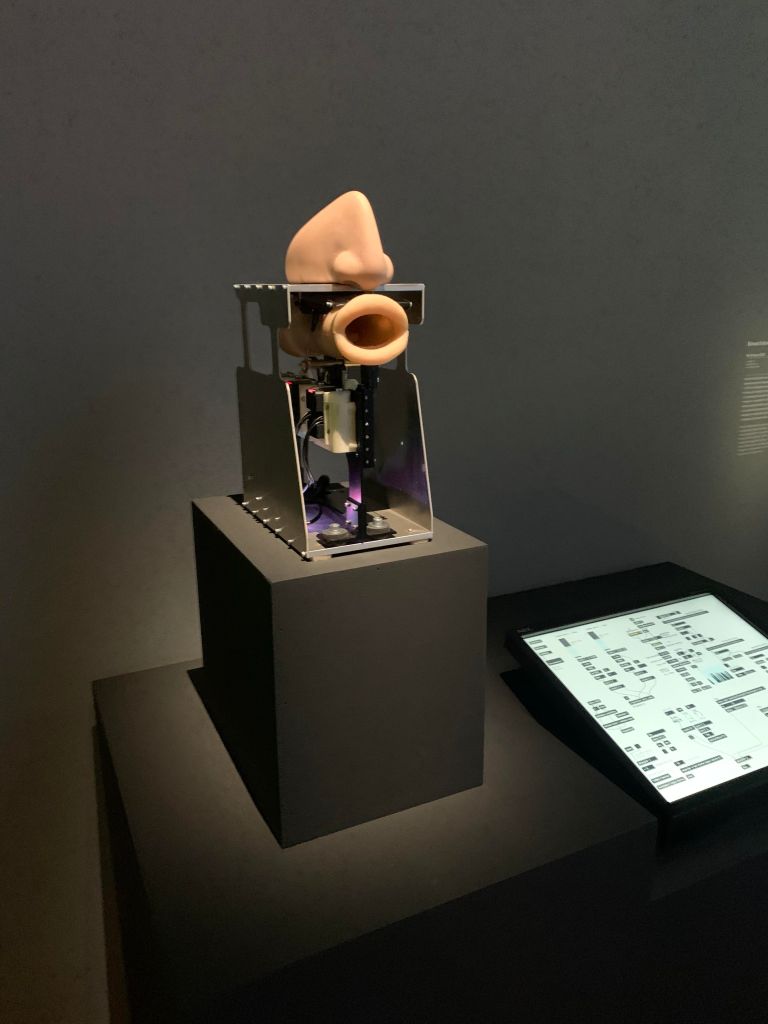
View #5
Centre Pompidou
The Prayer is presented in the show “Neurons, Simulated Intelligence”, at Centre Pompidou, Paris, curated by Frédéric Migayrou and Camille Lenglois from 26 February – 20 April 2020
While artificial intelligence appears to have invaded all the industrial fields of the contemporary world, from finance to medicine, games to behavior, architecture and the military, this transfer has as of 2019/20 never really been linked to the history of neuroscience and neuro-computation. The exhibition “Neurons, simulated intelligence” highlights the links between the research of artists, architects, designers and musicians, and that by major scientific laboratories or the industrial sector.
Diemut Talk at Ircam:
https://vertigo.ircam.fr/
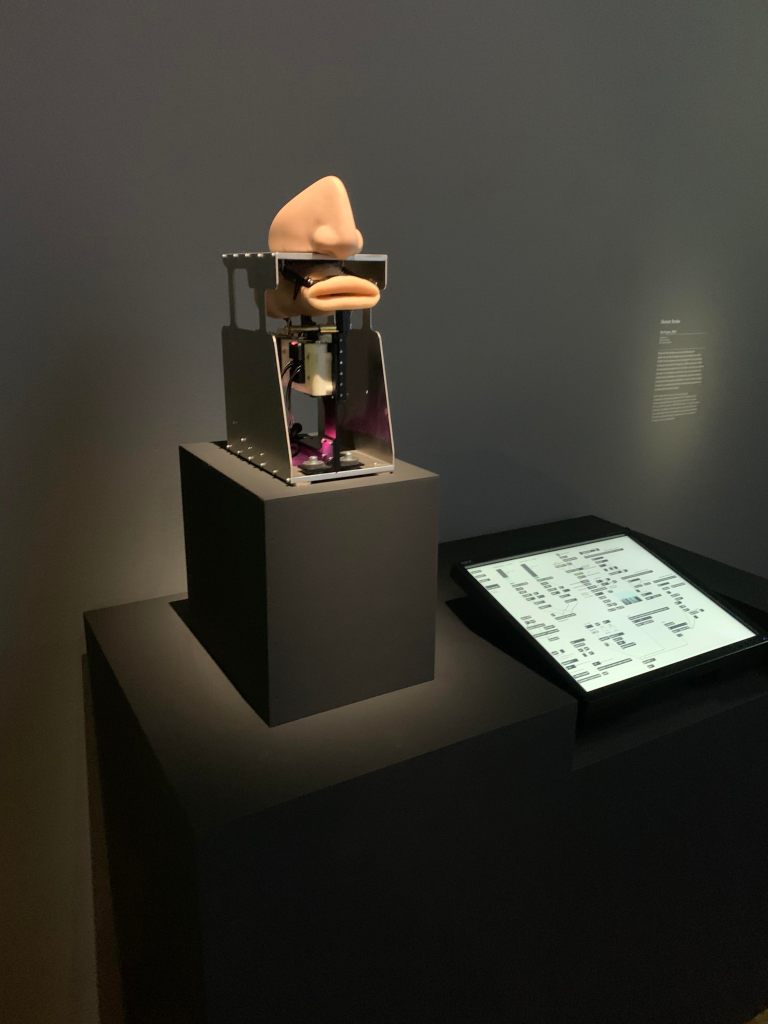
View #6
View of The Prayer presented in the show “Neurons, Simulated Intelligence” at Centre Pompidou, Paris, curated by Frédéric Migayrou and Camille Lenglois
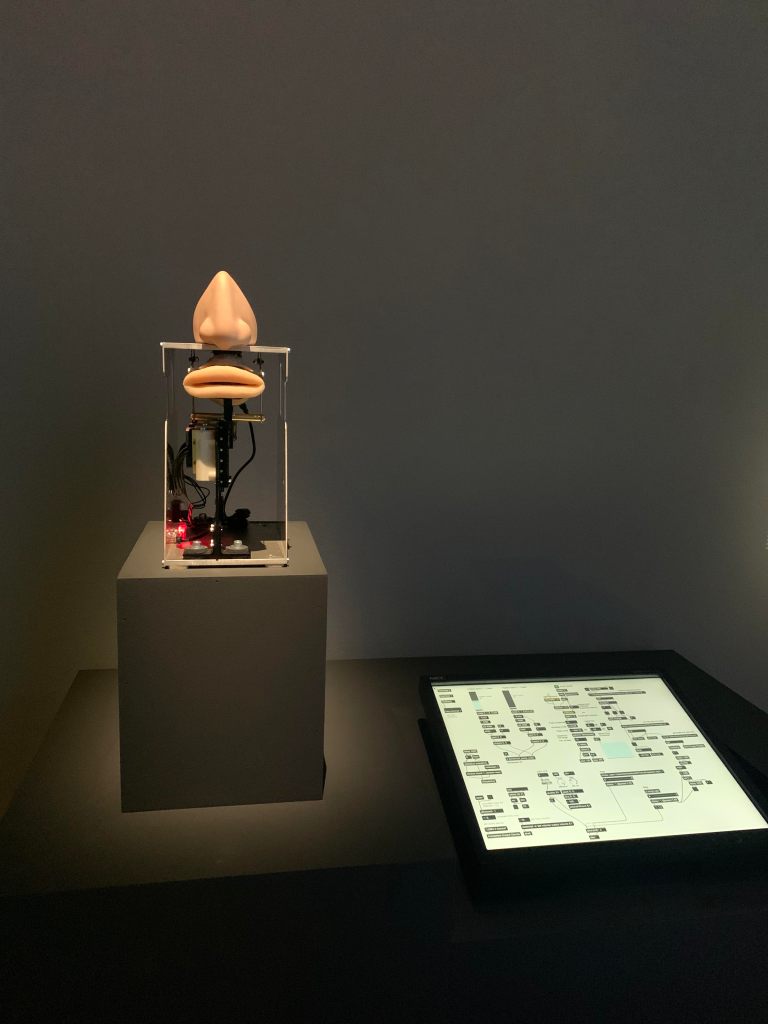
THE PRAYER at Centre Pompidou, Paris
2020
View #7
A view of The Prayer presented in the show “Neurons, Simulated Intelligence” at Centre Pompidou, Paris, curated by Frédéric Migayrou and Camille Lenglois
Diemut
CONTACT:
Collaboration
The project’s production is a collaboration with the following participants:
Regina Barzilay and Tianxiao Shen, MIT/ CSAIL, AI based pre-trained GPT-2 model of free text generation in real time.
Amazon Polly – AI based real time text to speech generation
Brian Kane, programming of sound- mechanical interface Max MSP, (main set up)
Matthew Azevedo, programming of sound – mechanical interface Max MSP and (non AI) audio production
Bill and Will Sturgeon, initial software set up, prototype mechanical design and construction
Stefan Strauss, support design and advice
Chris Fitch, engineering support
Keith Welsh, Webster University, and Diemut: text and prayer collection for database
Elchanan Mossel, advice
The project management is a partnership of Enrico Santus, who came on the project in 2019 and Diemut who started the project in 2018. The project lasted from 2018 – Feb 2020.
With extraordinary and special thanks to Hideyuki Sawada, Waseda University and Thanh Vo, The University of Danang, whose speech machine for the hearing impaired has been a point of departure for the design of the outer features of the artwork.
I also thank Bill and Will Sturgeon who sponsored the construction of the machine. In addition I thank Stephanie Lamprea, Francesco Prontrera, Alessandro Andriolo for their support as well as Paolo Andriolo, Roberto Capanna and Alessandro Berlato for making and sponsoring the website.
 Art Science